I Want to Go to University. So Why Does the Thought of It Make Me Nervous?
You have worked towards this for years.
University has been discussed at school, around the dinner table, during subject choices, exam preparation and conversations about what you want to do with your life.
Maybe you have already started researching institutions and courses. Maybe you have attended an open day. Maybe applications are going in. Maybe you are waiting for marks, offers or answers.
You want to go.
So why does the thought of actually getting there make you feel a little nervous?
The answer is surprisingly simple.
Because wanting something and feeling apprehensive about it can exist at the same time.
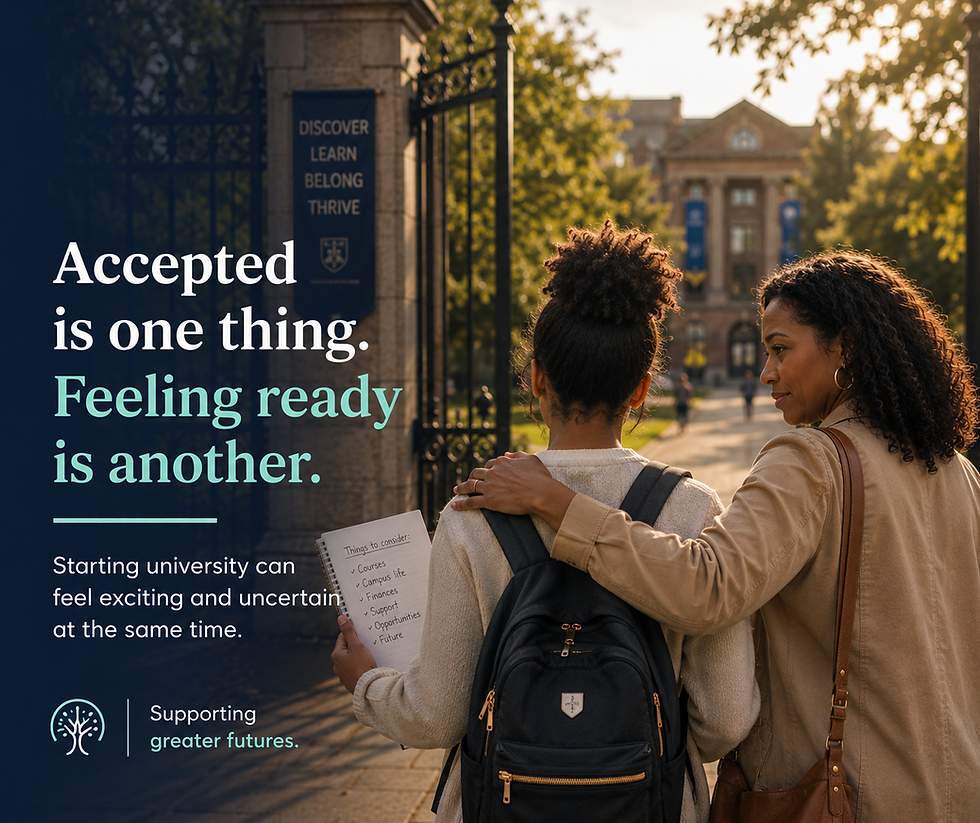
Everyone keeps asking if you’re excited
And perhaps you are.
But excitement is usually only part of the story.
University also means stepping into an environment that is very different from school.
There will be new people, new systems, new expectations and new responsibilities. You may be travelling further from home every day or moving away altogether. You may suddenly be responsible for managing your own timetable, deadlines, money, meals, transport and decisions in ways you have never had to before.
And somewhere in the middle of all of that, you are also expected to learn.
It is completely understandable to wonder:
What if I don’t cope?
What if the work is much harder than I expect?
What if I don’t make friends?
What if everyone else seems to know what they are doing?
What if I choose the wrong course?
What if I get there and realise I don’t know how any of this works?
These questions do not mean that you are not ready for university.
They mean you are thinking seriously about a very big transition.
The strange thing about preparing for university
A huge amount of preparation goes into getting into university.
You work on your marks. You research courses. You consider admission requirements. You apply. You fill in forms. You wait for results.
But there is another kind of preparation that receives far less attention:
Preparing for what happens after you arrive.
Because being accepted into university and knowing how to be a university student are not quite the same thing.
At school, much of your day is structured for you.
You know where you need to be. Teachers remind you about important dates. Someone notices if you are absent. Your timetable tells you where to go next. There are familiar routines, familiar faces and usually a fairly clear idea of what is expected of you.
University asks for much more independence.
Nobody is necessarily going to notice immediately if you are falling behind.
You may have large gaps between classes. Different lecturers may communicate in different ways. Deadlines can pile up across several subjects at once. You may need to ask questions, find information and solve problems yourself.
That freedom can be exciting.
It can also be a shock.
“But everyone else will know what they’re doing”
Here is one of the great illusions of starting university:
Everybody else looks as though they know exactly what is going on.
They usually don’t.
Some students will appear confident because they are naturally outgoing. Some will have siblings or parents who went to university and have already explained certain things to them. Some may be familiar with the campus. Others may simply be very good at looking calm while quietly wondering what on earth a tutorial is and whether they are supposed to bring something to it.
You are unlikely to be the only person with questions.
You may just be surrounded by people who are also waiting for someone else to ask them first.
Part of becoming a university student is learning that asking questions is not evidence that you do not belong there.
It is part of figuring out how the place works.
Your parents may be figuring it out too
There is another side to this transition that students sometimes do not see.
Your parents or guardians may be nervous as well.
They might be wondering whether you will cope with the workload, whether you will be safe, whether you will make good decisions, whether you will manage your money, or whether you will ask for help when you need it.
And for some parents, university itself is unfamiliar territory.
Perhaps they did not attend university.
Perhaps you will be the first person in your immediate family to do so.
That can be an incredibly proud moment for a family, but it can also mean that everyone is entering this new world without much of a frame of reference.
Your parent may be thinking:
I want to help my child prepare for this, but I don’t really know what university is like either.
That does not make them unable to support you.
It simply means that sometimes the student and the family are learning about the transition together.
So what does “university ready” actually mean?
It does not mean knowing everything before you arrive.
Nobody does.
It does not mean never feeling nervous.
And it certainly does not mean having your entire life mapped out at 17 or 18.
University readiness is partly academic, but it is also practical.
It is beginning to understand that you will need to manage your own time.
It is knowing that you may have to ask for help rather than waiting for somebody to notice that you need it.
It is learning how university structures and systems work.
It is understanding that a bad mark does not automatically mean you are incapable.
It is recognising that independence does not mean doing absolutely everything alone.
It is knowing that there will be unfamiliar situations and trusting that you can learn how to handle them.
Most importantly, it is understanding that preparation is not about removing every uncertainty.
It is about reducing the unnecessary ones.
You don’t need a crystal ball. You need a frame of reference.
Imagine arriving at university knowing nothing about what lies ahead.
Every unfamiliar term, process or expectation becomes another small surprise.
Now imagine arriving with some understanding of how university works, what may be expected of you, where common challenges tend to arise and what you can do when they do.
The university experience itself has not changed.
But your starting point has.
That is the value of preparing for the transition before you are standing in the middle of it.
You cannot predict exactly what your first year will look like.
You can, however, make sure that not everything feels completely unfamiliar when you get there.
And if you are nervous?
That is okay.
You can be excited about university and apprehensive about it.
You can want independence and still wonder whether you are ready for it.
Your parents can be proud of you and still worry.
None of those things contradict each other.
A major life change is allowed to feel big.
The goal is not to arrive at university knowing everything.
The goal is to arrive knowing enough that you can start asking the right questions, making informed decisions and finding your feet.
Because you do not need to have university completely figured out before your first day.
But a little preparation can mean you spend less of your first semester figuring everything out the hard way.
A thought for parents and schools
Helping a learner qualify for university is an enormous achievement.
Helping them understand what they are stepping into is another kind of preparation altogether.
At LSP, we believe students are better equipped to navigate important educational transitions when they have a clearer frame of reference before they need it.
That is one of the ideas behind the LSP Undergraduate Toolkit: practical guidance designed to help students better understand and navigate the journey into and through university.
Because sometimes confidence does not come from having all the answers.
It comes from knowing a little more about what lies ahead.